


28 August 2026
NEWS RELEASE
Industry support advances rock engineering research in South Africa
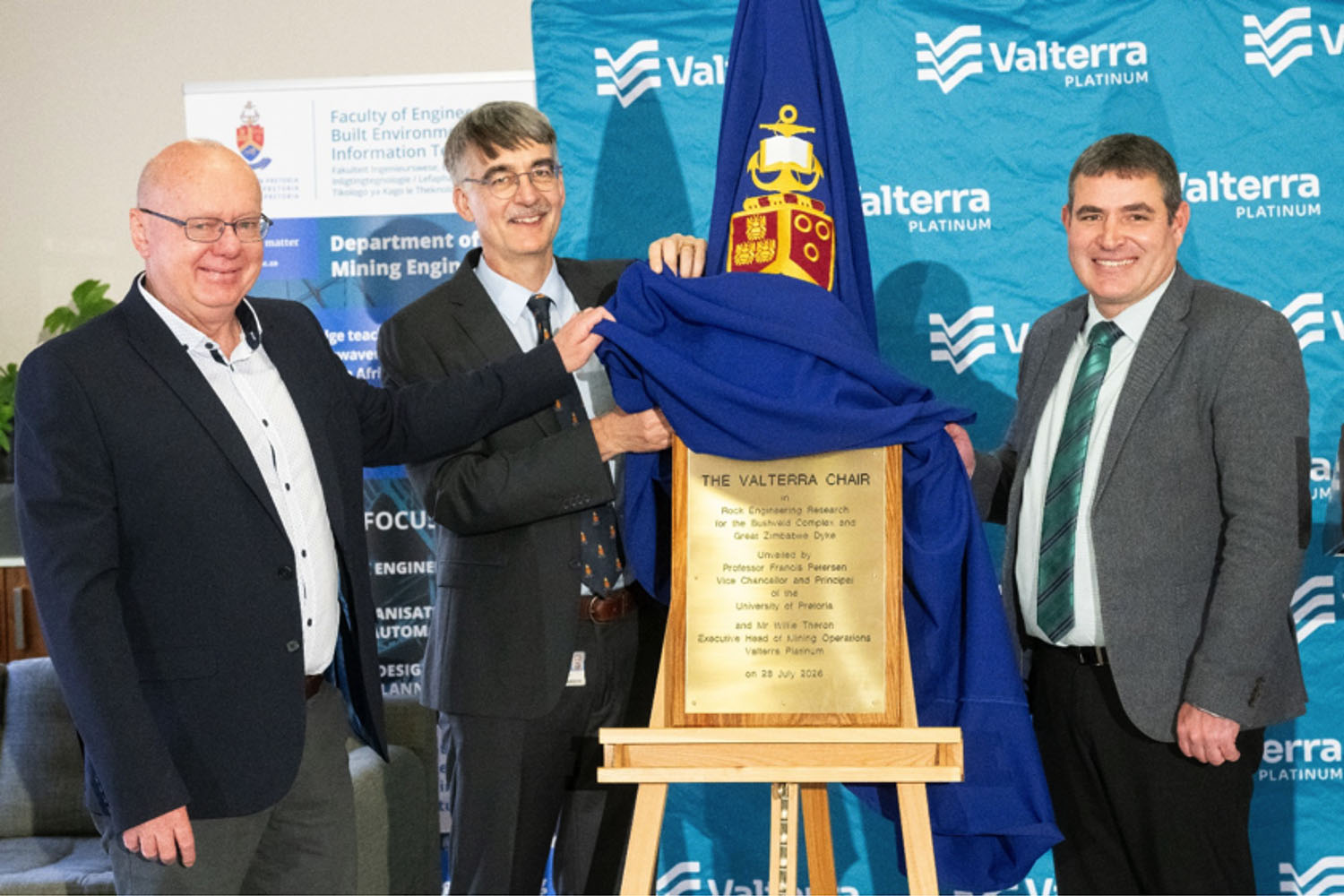
Unveiling the plaque at the launch of the Valterra Platinum Chair in Rock Engineering Research for the Bushveld Complex and Great Zimbabwe Dyke are (from left) Prof Francois Malan, Head of the Department of Mining Engineering, University of Pretoria, Prof Wynand Steyn, Dean of the Faculty of Engineering, Built Environment and Information Technology, University of Pretoria, and Willie Theron, Executive Head: Mining Operations, Valterra Platinum
PRETORIA – The support of Valterra Platinum to the University of Pretoria’s rock engineering research is enabling the Department of Mining Engineering in the Faculty of Engineering, Built Environment and Information Technology to strengthen its reputation as an international leader in this field and as a trusted partner in advancing knowledge that serves society. The Valterra Platinum Chair in Rock Engineering for the Bushveld Complex and Great Zimbabwe Dyke will provide funding for an initial period of three years for research in this field.
The event was a celebration of the spirit of collaboration between industry and academia. It is anticipated to become a catalyst for groundbreaking discoveries, stronger partnerships and lasting impact that can improve mining safety, support economic growth and contribute to a more sustainable future in the southern African region.
Traditionally, most of the rock engineering research in South Africa has focused on the country’s gold mines. The layout challenges of the shallow mines in the Bushveld Complex for platinum group metals (PGMs), chromium and vanadium have largely been ignored. This Research Chair will therefore enable the Department’s research activities to be expanded to the Bushveld Complex and the Great Zimbabwe Dyke with the objective of advancing the country’s economy.
Speaking on behalf of Prof Francis Petersen, the University’s Vice-Chancellor and Principal, Prof Wynand Steyn, Dean of the Faculty of Engineering, Built Environment and Information Technology, expressed his appreciation to Valterra Platinum for its valued support. “This Research Chair is an important vehicle to enable fundamental rock engineering research on the layouts and rock types found in these mines.”
He emphasised that the launch of the Research Chair represents a shared commitment to addressing complex challenges through research, innovation and meaningful partnership. “It demonstrates what is possible when academia and industry come together with a common purpose: to generate knowledge that makes a tangible difference.” Mining has played a defining role in South Africa’s economic development, and continues to be fundamental to the prosperity of the country and the region. Yet, industry faces increasingly complex technical, safety and sustainability challenges that demand new thinking, rigorous scientific inquiry and highly skilled professionals.
“As a leading research-intensive university,” he added, “the University of Pretoria is committed to producing knowledge that not only advances academic excellence, but contributes to solving real-world problems.” Its vision is to create a future in which its research serves society, drives innovation and supports sustainable development across Africa and beyond.
The establishment of this Research Chair reflects that commitment. It builds on South Africa’s rich legacy of excellence in rock engineering research, while helping to strengthen a field that has seen a decline in research capacity over recent decades. Importantly, it creates an opportunity to develop new knowledge that will enhance both the safety and productivity of mining operations in the Bushveld Complex and the Great Zimbabwe Dyke – regions of enormous strategic importance to the global mining industry.
Prof Steyn noted that, equally significant, is the investment this Research Chair makes in people. “Research Chairs are not only about advancing science; they are about nurturing the next generation of researchers, engineers and innovators.” Through postgraduate education, mentorship and collaborative research, this initiative will help develop the expertise that our country and the continent needs well into the future.
He concluded his address by expressing his sincere appreciation to Valterra Platinum for its confidence in the University of Pretoria and for recognising the value of long-term investment in research. “Partnerships such as this demonstrate that industry and academia can achieve far more together than either can achieve alone.”
Prof Francois Malan, Head of the Department of Mining Engineering, provided the stakeholders attending the launch with the historical context of the Research Chair, emphasising the fact that early research in mining engineering was identified as an essential need after the Coalbrook mining disaster at the Clydesdale Colliery in January 1960. Following the sudden structural disintegration of approximately 900 underground coal support pillars, a large part of this mine collapsed and 437 miners died. However, government support of mining research has waned.
“Although government support of mining research has waned since the turn of the century, the mining industry’s problems have not diminished,” he said. “It is now up to industry to provide the necessary funding for vital academic research in this area.” He explained that the proposed research to be conducted in the Valterra Platinum Chair will focus on topics that are deemed critical to improve the productivity and safety of the mines in the Bushveld Complex and Great Zimbabwe Dyke.
Postgraduate research in this field will be supervised by internationally recognised rock engineering researchers associated with the Department of Mining Engineering, such as Prof John Napier and Prof Francois Malan, who have both been acknowledged for their expertise in this field by the International Society for Rock Mechanics. Several master’s and doctoral studies are already under way as part of the Research Chair, and the Department encourages mining engineers engaged in work in the field, especially those from the sponsoring company and others who, on a daily basis, deal with the challenges related to mine layouts and pillar design in the country’s gold and platinum mines, to participate in the activities of the Research Chair. He also welcomes collaboration with the University’s Department of Materials Science and Metallurgical Engineering.
Concluding the event, Willie Theron, Executive Head: Mining Operations at Valterra Platinum, expressed his excitement at his company’s involvement in this prestigious initiative. “At a time when industries are being reshaped by artificial intelligence and digitalisation, it is a privilege for Valterra Platinum to support research in this critical field.” He explained that it demonstrates that there remains a wealth of discovery and learning in the fundamental principles of mining. It furthermore builds on a well-established relationship between academia and the mining industry.
As an alumnus of the University of Pretoria, who completed his master’s research in the Department of Mining Engineering in May 2025, he is encouraged by the fact that there remains significant potential to deepen our understanding, and yield new knowledge, new techniques and innovation that can contribute meaningfully to the future of safe, smart mining. This includes collaboration with disciplines such as metallurgical engineering, civil engineering, mathematics and construction management.
He shared his belief that mining remains a critical industry in our country’s future. In this regard, he considers mining engineering and rock engineering to be synonymous. Since the minerals that are mined are finite, they are a strategic resource, and optimising the design of mine pillars will go a long way to unlocking value and increasing access to the valuable minerals that are so essential to the sustainability of the industry.
“The onus is on us to ensure the continued livelihood of the many communities affected by mining in South Africa,” he says. In the case of platinum group metals, Valterra Platinum’s responsibility to produce and market these strategic metals has led to it emerging as a standalone company that supports more than 40 000 livelihoods, directly and indirectly. “In alignment with our purpose of unearthing value to better our world, we believe that, although the metals we produce are absolutely vital for progress, this cannot be to the detriment of families and communities, which is why we subscribe to the imperative of zero-harm, and encourage research that contributes to this imperative.”
He added that, as much as we can celebrate the importance and implied value of the metals entrusted to us in our national endowment, we cannot take anything for granted, and we certainly cannot say that we know everything there is to know about the extraction and beneficiation of these metals. Reflecting that the first universities in Gauteng were established with strong support from mining interests, he recognises the fact that the long-term success of the industry depends on knowledge, innovation and skills development. What he therefore finds so exciting about this Research Chair is that it will be able to facilitate the advanced research that the industry needs.
At a time of unprecedented technological advancement and a drive towards safety in the mining industry, it also provides the opportunity to cultivate new expertise and create opportunities for future generations of graduates. “The prospect of developing new skills, advancing research and helping to shape meaningful and rewarding careers in this field is extremely exciting for us, not only as a company, but as an industry.”
Theron revealed his enthusiasm in the proposed research topics being considered as part of the Research Chair. They speak to the challenges of industry, as well as the challenges that Valterra Platinum is currently faced with – from optimised multi-reef extraction strategies to pillar design research at Amandelbult, and pillar behaviour at the Unki mine in Zimbabwe. “We welcome collaboration and the introduction of new knowledge because, as much as we have an incredible natural mineral endowment in southern Africa, this is an incredibly competitive global industry, and we need to ensure the sustainability of the industry.”
He considers the establishment of the Research Chair to be an investment in Valterra Platinum’s long-term sustainability, as well as an investment in young people and in the country’s economic prosperity. “We anticipate it strengthening our talent pipeline, building academic interest in mining, and fostering the research and innovation required to solve the complex challenges that will benefit the industry as a whole.”
In conclusion, Theron stated that Valterra Platinum is proud to be part of the journey of creating new knowledge, and looks forward to seeing world-leading research, case studies and innovations emerging from this partnership.
--- End ---
Media enquiries can be directed to Mr Sashlin Girraj - Public Relations & Events Manager Email: sashlin.girraj@up.ac.za | Cell: +27(0)72 447 3784
ABOUT THE UNIVERSITY OF PRETORIA
The University of Pretoria (UP) is one of the largest contact and residential universities in South Africa. Spread over seven campuses, it has nine faculties and a business school, the Gordon Institute of Business Science (GIBS). It is the only university in the country with a Faculty of Veterinary Science, which is ranked the best in Africa. UP has 120 academic departments and 92 centres and institutes, accommodating more than 56 000 students and offering about 1 100 study programmes. It has the most academic staff with PhDs (70%), NRF-rated researchers (613).
The 2025 Times Higher Education (THE) Impact Rankings placed UP 7th globally for Sustainable Development Goal (SDG) 17: Partnerships for the Goals, recognising the University's leadership in building impactful global collaborations. UP also ranked 41st in the world and 1st in Africa and South Africa for SDG 16: Peace, Justice and Strong Institutions, and maintained its position as the second-highest ranked university overall in both Africa and South Africa.
The 2025 Times Higher Education subject rankings placed UP first in South Africa in the fields of Accounting and Finance; Architecture; Electrical and Electronic Engineering; Law; Sport Science; and Veterinary Science. UP’s Faculty of Law has been ranked as the top law school in Africa for a remarkable eighth consecutive year. In the 2025 QS World University Subject Rankings, UP is ranked in the top 100 in the world in Mineral & Mining Engineering (41), Veterinary Science (51–60), and Development Studies (51–100). Six UP subjects are ranked No. 1 in South Africa: Mechanical Engineering, Veterinary Science, Mathematics, Accounting & Finance, Business & Management Studies, and Economics & Econometrics.
For more information, please go to www.up.ac.za
